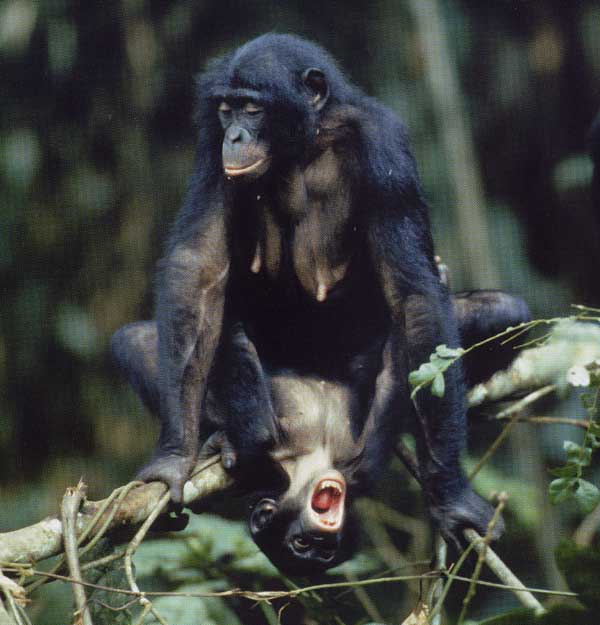
Bonobos are not totally peaceful, but reports have been greatly exaggerated
John Hawks has a
great review of the commentary following Ian Parker’s
New Yorker article "
Swingers" on bonobos as well as
Frans de Waal’s response in eSkeptic. I’ve previously commented about this issue
here and
here. However, I disagree somewhat with my fellow anthro blogger that de Waal is accusing Parker of having a political agenda. De Waal points out that conservative pundits picked up on this article in order to, following Parker’s phrase, “use the species as a stick to beat” their ideological drum. What de Waal points out is that Parker was merely “sexing up” his article to raise a little controversy.
Parker presented his trip as a fact-finding mission that had unearthed revolutionary new insights. His message was that bonobos are killer apes, just like their cousins, the chimpanzees. The animal kingdom remained “red in tooth and claw,” as it ought to be.
Yet, the most striking cases of bonobo aggression that he reported have been known for decades, and actually didn’t come from the natural habitat, even less from first-hand observation by our brave explorer.
Challenging a widely held view, even without anything dramatically new to report, is a standard journalistic hook in order to generate audience interest. Whether Parker intentionally chose this tactic or whether it just seemed to be the most exciting way to tell the story isn't all that important. It was a beautifully written piece on the difficulties of fieldwork which ultimately contained flaws about bonobo social behavior.
Parker quotes primatologists Gottfried Hohmann and Craig Stanford (two researchers I greatly respect) in such a way that it implies de Waal has been wrong in his interpretations since he’s never done field work himself. Stanford had some of the most critical statements but, since he’s never done fieldwork with bonobos either, these aren't as relevant as Hohmann's. However, while Hohmann has published some exciting field results showing that bonobo behavior could be more flexible than previously thought, his findings do not contradict de Waal’s interpretations.
For example, Parker takes issue with de Waal's statement that:
“Who could have imagined a close relative of ours in which female alliances intimidate males, sexual behavior is as rich as ours, different groups do not fight but mingle, mothers take on a central role, and the greatest intellectual achievement is not tool use but sensitivity to others?”
Taking each point individually, compare that with the following statements from Hohmann's publications:
1. “Aggression by males against females was rare and was almost never followed by mating between aggressor and target. Female aggression against males occurred frequently but appeared to be independent of mating behaviour.” Behaviour (2002).
2. “Why females of the two Pan species differ in their [genito-genital] displays of social status remains a challenge for future research. The finding that bonobos perform this behaviour so regularly indicates that social status is an important issue for the females of this species. Because of their frequent use, dyadic performance, spatial variability and behavioural plasticity, we suggest that genital contacts can be used to investigate the quality and dynamics of social relationships among female bonobos.” Animal Behavior (2000).
3. “Bonobos show an opportunistic and promiscuous mating behaviour, even with mates from outside the community.” Proceedings: Biological Sciences (1999). Also see Primates (2001) for a short communication involving tolerance of strangers.
4. “The lasting bonds between mothers and sons may be a substitute for male coalitions serving rank acquisition in chimpanzees.” Behaviour (1999).
Other than de Waal's final comment about intellectual achievement (which is a value judgment, even though
bonobo empathy has been shown to be greater than chimpanzees) the two researchers don't differ substantially on these points. Parker didn't include this common ground but opted to create a wedge between Hohmann and de Waal. This opened the door for political pundits to declare victory that the bonobo "myth" had been disproved (which shows what standard of evidence they embrace).
However, it's important to point out that new field data has provided more complexity to the social lives of bonobos (and of chimpanzees as well). The excellent book
Behavioural Diversity in Chimpanzees and Bonobos (of which Hohmann was a co-editor) shows how different environmental conditions bring out different sides to these species. An in depth review of this book can be found
here.
Fortunately, and with all criticism aside, any discussion about bonobos can only aid in the conservation of this
critically endangered species as it will activate their strongest base of supporters and bring them to the attention of others who may have never known there was more than one "chimpanzee." I also salute Parker’s dedication for taking such an arduous journey to watch bonobos personally, as brief as that may have been.
However, John Hawks is absolutely correct that Parker's misrepresentations are minor compared to some other blunders in science journalism. It's important for researchers to continually challenge those interpreting scientific results for the public so that such misrepresentations will be minimized.
Currently Gottfried Hohmann and Frances White are conducting field work in the region (I conducted an
interview with Dr. White earlier about bonobo behavior). It will be exciting to learn what new insights are discovered about our evolutionary cousins.

 [Read more →]