Rejection of authority and working-class values inspired the scientific method.
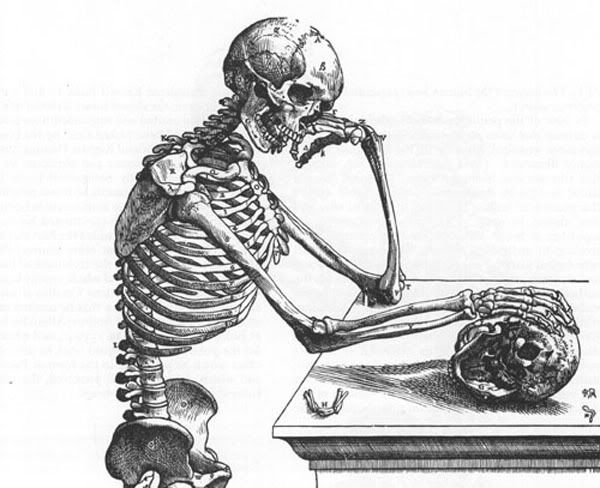
Drawing by Renaissance physician Vesalius
As everyone knows, when food is digested it is processed into chyle and turned into blood by the liver. This blood then flows to the lungs where it releases any impurities into the air. Flowing from the lungs into the left ventricle of the heart the blood then mixes with air and is charged with animal spirit – where it changes from dark purple to bright red. This charged blood then passes through the arteries and throughout the body.
At least, if you had lived anywhere in the Western world up until the early 1600s this would have been common knowledge. This system developed between 150 and 200 AD by the Greek physician Galen was viewed as medical dogma by centuries of physicians and professors to follow. The revolution that accompanied the rejection of Aristotelian physics with Copernicus, Kepler and Galileo found its biological equivalent in the work of physicians operating at the same time in the form of Paracelsus, Vesalius and Harvey.
Revolutionary insights in biology during the Renaissance aren’t as well known as in the physical sciences, and the biological revolution is generally reserved for the publication of Darwin’s
On the Origin of Species. However, beginning in the 1520s, the seeds of revolution were being sown as physicians and professors alike began to reveal the disparities in Galen’s classical texts on anatomy and medicine. The first of these revolutionary voices was that of Phillip von Hohenheim, later adopting the title of Paracelsus (meaning “greater than Celsus,” a Roman encyclopedist of medicine from the first century AD).
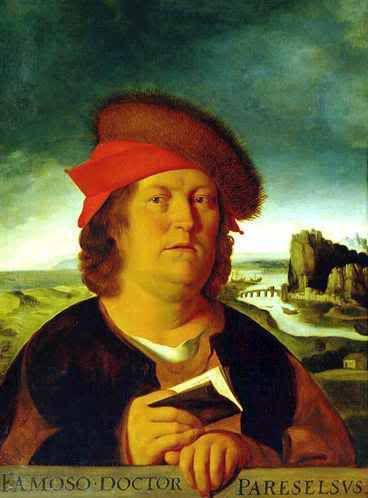
Paracelsus announced his revolution by publicly burning
the standard medical text.Paracelsus was born and raised in Switzerland and began his revolution in biology twenty years before Copernicus published the book that officially marks the beginning of the scientific revolution. This break from ancient dogma was clear from the very beginning. As I. Bernard Cohen writes in his
Revolution in Science:
When Paracelsus was appointed municipal physician and professor at Basel in 1527, he declined taking the normal oath; rather, he issued a broadside declaring his disagreement with Galenic principles and announcing a new system of medicine. It was only a few months later (24 June 1527) that he publicly burned a copy of the standard textbook of the day, Avicenna’s Canon of Medicine” (183).
This breach with established authority could well provide a new beginning point for the scientific revolution, arriving just ten years after Martin Luther nailed
The 95 Theses to the door of the Castle Church. However, this biological revolution may have been more of a revolution in the practice of science rather than what was actually being discovered. Paracelsus rejected “organized religion and classical scholarship” and was described as having an “unwillingness to make concessions to custom and authority.” Most notably, he outraged his contemporaries by lecturing directly to the local people in German rather than the more erudite Latin and for inviting the lowly barber-surgeons to his courses. This suggests that Paracelsus had a closer bond with working people than with the paragons of academia. Perhaps from this perspective Paracelsus was more willing to use a hands-on approach to his research that involved his own dissections (rather than merely referring to Galen) and experimentation with chemical cures for disease.
Unlike the Galenists, who believed disease was the result of an internal disorder between the four humors (blood, phlegm, yellow bile and black bile), Paracelsus thought that disease was the result of “a specific agent foreign to the body” from the air that acted as a parasite on an otherwise healthy individual (the microscope wouldn’t be invented for another seventy years so the germ theory of disease was a distant idea). This frame of reference (external agents rather than internal humors) had a profound impact on the practice of medicine. For Paracelsus, if a foreign agent was responsible for disease, than a reagent could counter it. Experimental medicine, in the form of chemistry, was the Paracelsian innovation.
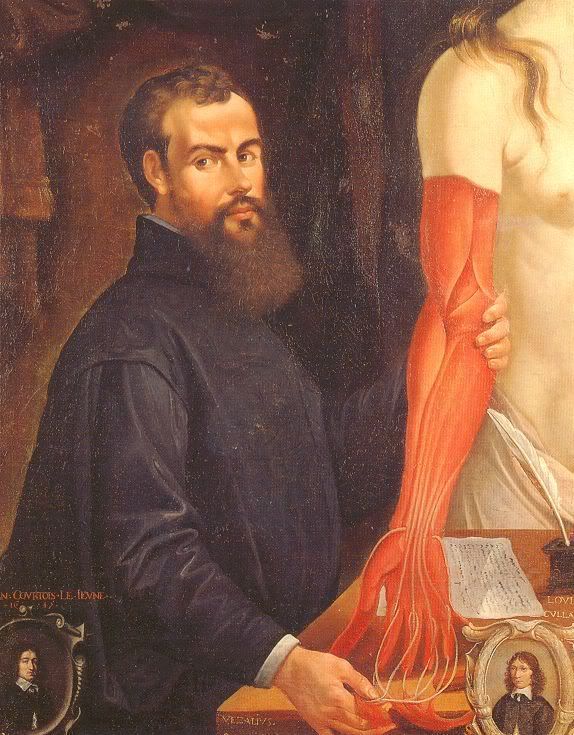
Vesalius from his On the Fabric of the Human BodyThis innovation was continued in the work of Andreas Vesalius. In 1537, still five years before
On the Revolutions of the Heavenly Spheres would be published on Copernicus’ deathbed, Vesalius continued Paracelsus’ revolution (though without embracing his ideas) by deciding for himself whether the ancients were correct. Even at the tender age of twenty-three Vesalius demonstrated his break with the traditional order:
“From the start he showed his independence, for in his anatomical lectures and demonstrations . . . he broke with tradition and, ‘contrary to custom . . . himself performed the dissections rather than consigning that task to a surgeon’” (177).
His willingness to challenge established authority led him to offer detailed critiques of the Galenic texts that were revered by medical authorities. However Vesalius broke not just with the ancients but also with his contemporaries, feeling the medical establishment taught in such a way that there was “very little offered to the students that could not be taught by a butcher in his shop.” This “do-it-yourself” attitude that is more akin to craftsmen than the paragons of academia is also apparent in Vesalius’ book
On the Fabric of the Human Body in which he offered detailed instructions (including a list of tools) that a student could use to perform their own dissections and “arrive at an independent conclusion” from either himself or Galenic dogma.
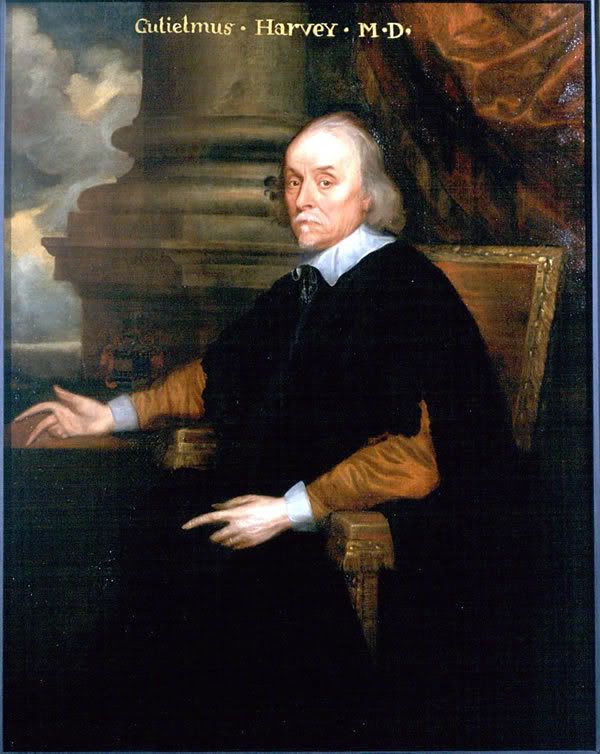
William Harvey broke completely with Galenic biologyThe anatomist William Harvey then codified the revolution in biology begun by Paracelsus and Vesalius. As the first to discover that the heart pumps the blood through a single circulatory system, his work marks the radical break from Galen that earlier researchers had initiated. Receiving his doctorate in medicine in 1602, Harvey would have been well familiar with the then notorious Copernicus and was a contemporary of Kepler, Descartes and Galileo (the latter was even a young professor at the University of Padua where Harvey received his degree). By now the independent research model of science (rather than mimicry of the ancients) was well established and Harvey initiated original investigations on more than eighty species including humans.
“What Harvey did was to determine, by actually making measurements, the capacity of the heart in humans, dogs, and sheep. Then by multiplying this number by the pulse rate, he computed how much blood is transferred from the heart to the arteries – approximately 83 pounds of blood in each half-hour.” (191).
Harvey acknowledged his firm break with Galen and the ancients and announced his revolutionary intentions when he stated “this book of mine was the only one to oppose tradition and to assert that the blood traveled along a previously unrecognized circular pathway of its own” but he feared that “I may suffer from the ill-will of a few, but dread lest all men turn against me.” However, like Copernicus it would take many years before the insights he published were picked up and appreciated for the revolutionary break with tradition that they were.
“Harvey created a single circulatory system with a single center (the heart) to replace the multiple systems of Galen. This was a similar achievement to the creation of a single system of the world by Copernicus, and especially Kepler, to replace the collection of separate systems in Ptolemy’s Almagest. Similarly, Harvey’s devastating proof of the falsity of the Galenic doctrine may be likened to Galileo’s proof that the Ptolemaic system for Venus does not accord with reality” (194).
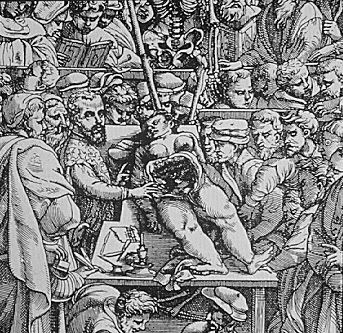
Drawing of Vesalius in a public demonstration of anatomyThe independent research and experimentation of science rather than obeisance to authority, a practice that had more in common with working craftsmen than the educated elite, may well have been the crucial ingredient that spawned the scientific revolution. The bridging of innovation and knowledge from the bottom-up rather than the top-down method that regurgitated Aristotle and Galen for generations, offered the freedom to innovate and imagine new systems of knowledge. If science is to continue to thrive it will be by embracing this revolutionary spirit of independence in thought and originality in experimental design. Researchers today owe a tremendous debt to the craftsmen and science enthusiasts of yesteryear who inspired this revolutionary drive and earned the authority that the scientific method currently holds.
[Read more →]