ERIC MICHAEL JOHNSON
_____________________________________________________________________________________________________

"If the misery of the poor be caused not by the laws of nature, but by our institutions, great is our sin."
- Charles Darwin
_____________________________________________________________________________________________________
Showing posts with label climate crisis. Show all posts

Mar 31, 2009

Loss of Biodiversity and Extinctions

Anup Shaw over at Global Issues has collected an exhaustive collection of recent analysis on the loss of biodiversity in the last few years.

As I wrote in my recent post Rivalry Among the Reefs, the loss of up to 1/3 of coral reefs in recent years could result in unprecedented extinctions of ocean biodiversity.

While occupying only 0.2 percent of the world’s oceans, coral reefs sustain 25 percent of species diversity; an oceanographic public works project that has been in existence for 3.5 billion years. . . Current estimates are that one-third of the world’s coral reefs are in imminent danger of extinction. In an international survey of these most diverse ecosystems in our oceans, researchers determined that global climate change is increasing the average temperature of the Earth’s oceans. This is killing the photosynthetic algae that has adapted into a pristine symbiotic relationship with their hosts. Coral bleaching on a global scale is the result and mass extinction will be the inevitable conclusion unless this trend is reversed.
But loss of biodiversity in the oceans is only one region currently experiencing crisis. The collection of studies and warnings from experts around the world that Anup has gathered are truly staggering. See below for a sample of some of what he posts:

Already resources are depleting, with the report showing that vertebrate species populations have declined by about one-third in the 33 years from 1970 to 2003. At the same time, humanity’s Ecological Footprint—the demand people place upon the natural world—has increased to the point where the Earth is unable to keep up in the struggle to regenerate.
- World Wide Fund for Nature, October 24, 2006

The world environmental situation is likely to be further aggravated by the increasingly rapid, large scale global extinction of species. It occurred in the 20th century at a rate that was a thousand times higher than the average rate during the preceding 65 million years. This is likely to destabilize various ecosystems including agricultural systems.
- Jaan Suurkula, Physicians and Scientists for Responsible Application of Science and Technology, February 6, 2004

If current estimates of amphibian species in imminent danger of extinction are included in these calculations, then the current amphibian extinction rate may range from 25,039–45,474 times the background extinction rate for amphibians. It is difficult to explain this unprecedented and accelerating rate of extinction as a natural phenomenon.
- Malcom MacCallum, Journal of Herpetology, July 17, 2007

Junk-food chains, including KFC and Pizza Hut, are under attack from major environmental groups in the United States and other developed countries because of their environmental impact. Intensive breeding of livestock and poultry for such restaurants leads to deforestation, land degradation, and contamination of water sources and other natural resources. For every pound of red meat, poultry, eggs, and milk produced, farm fields lose about five pounds of irreplaceable top soil. The water necessary for meat breeding comes to about 190 gallons per animal per day, or ten times what a normal Indian family is supposed to use in one day, if it gets water at all.
- Vandana Shiva, Stolen Harvest, (South End Press, 2000), pp. 70-71


[Read more →]
Loss of Biodiversity and ExtinctionsSocialTwist Tell-a-Friend

Oct 12, 2007

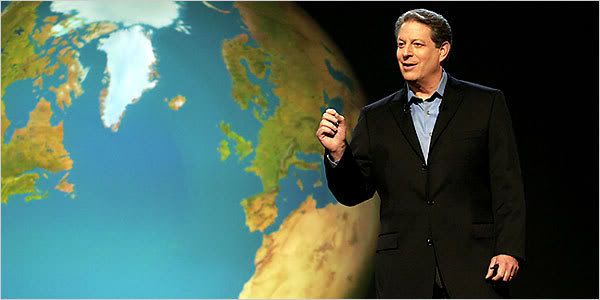
Al Gore Wins Nobel Peace Prize

Climate crisis advocacy earns world's highest humanitarian honor


An Inconvenient Truth crowned a career raising issues about global climate change

The Norwegian Nobel Committee decided today that the 2007 Nobel Peace Prize would be shared between the Intergovernmental Panel on Climate Change (IPCC) and former Vice-President (and future Presidential candidate?) Al Gore.

As the Nobel Committee announced today:


Indications of changes in the earth's future climate must be treated with the utmost seriousness, and with the precautionary principle uppermost in our minds. Extensive climate changes may alter and threaten the living conditions of much of mankind. They may induce large-scale migration and lead to greater competition for the earth's resources. Such changes will place particularly heavy burdens on the world's most vulnerable countries. There may be increased danger of violent conflicts and wars, within and between states.

While Al Gore hasn’t faced the trials in his work that previous winners such as Wangari Maathai or Riboberta MenchĂș have had to encounter (both of whom risked their lives to promote social justice), there’s no doubt that he deserves tremendous credit for bringing this issue into the mainstream. The concerns over global climate change need to be continually emphasized so people will finally awaken from their comas and make the necessary changes in their lives to affect real change.

As I’ve highlighted in previous posts (for examples see Climate Change and the Causes of War and African Exodus Linked to Global Climate Change) the disruption of the global temperature is likely to initiate a social crisis and could well lead to an extinction event unprecedented in 65 million years. This, I think, would be a bad thing. So while conservatives continue to underplay the seriousness of this issue it’s refreshing to find the Nobel Committee behaving as genuine conservatives and emphasizing the side of caution.


[Read more →]
Al Gore Wins Nobel Peace PrizeSocialTwist Tell-a-Friend

Sep 27, 2007

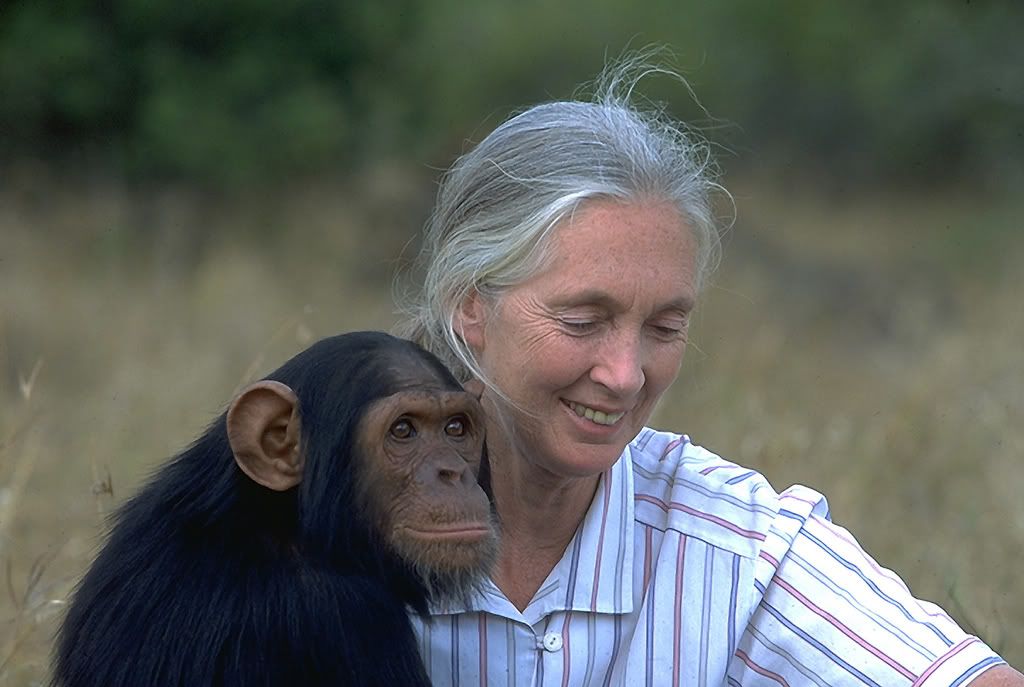
Jane Goodall Speaks Out on Biofuels

Primatologist highlights environmental damage of emerging "green" market.


Primate scientist Jane Goodall said on Wednesday the race to grow crops for vehicle fuels is damaging rain forests in Asia, Africa and South America and adding to the emissions blamed for global warming.

"We're cutting down forests now to grow sugarcane and palm oil for biofuels and our forests are being hacked into by so many interests that it makes them more and more important to save now," Goodall said on the sidelines of the Clinton Global Initiative, former U.S. President Bill Clinton's annual philanthropic meeting.

As new oil supplies become harder to find, many countries such as Brazil and Indonesia are racing to grow domestic sources of vehicle fuels, such as ethanol from sugarcane and biodiesel from palm nuts.

The United Nations' climate program considers the fuels to be low in carbon because growing the crops takes in heat-trapping gas carbon dioxide.

But critics say demand for the fuels has led companies to cut down and burn forests in order to grow the crops, adding to heat-trapping emissions and leading to erosion and stress on ecosystems.

"Biofuel isn't the answer to everything; it depends where it comes from," she said. "All of this means better education on where fuels are coming from are needed."

Goodall said the problem is especially bad in the Indonesian rain forest where large amounts of palm nut oil is being made. Growers in Uganda -- where her nonprofit group works to conserve Great Apes -- are also looking to buy large parcels of rain forest and cut them down to grow sugar cane, while in Brazil, forest is cleared to grow sugar cane.

The Goodall Institute is working with a recently formed group of eight rain forest nations called the Forest Eight, or F8, led by Indonesia. The group wants to create a system where rich countries would pay them not to chop down rain forests and hopes to unveil the plan at climate talks in Bali in December.

Scientists from the forested countries are trying to nail down exactly how much carbon dioxide the ecosystems store, but the amount has been estimated to be about double that which is already in the atmosphere, Goodall said.

Source: Reuters


[Read more →]
Jane Goodall Speaks Out on BiofuelsSocialTwist Tell-a-Friend

Climate Change and the Causes of War

New study makes Pentagon report all the more alarming.


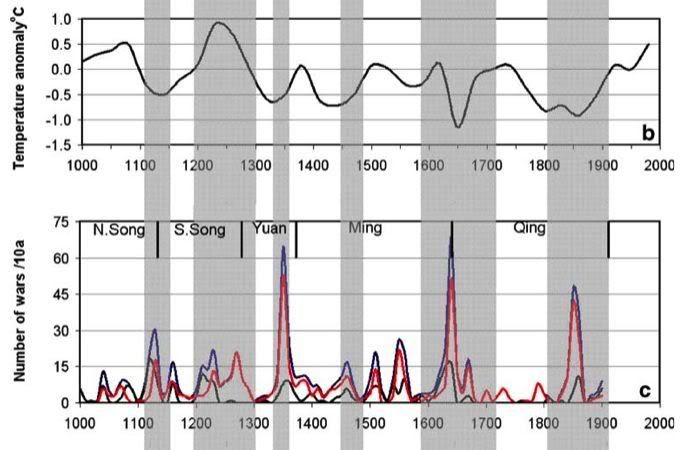
Periods of warfare in ancient China peaked during climate crises (in grey).

A fascinating article in the latest edition of Discover magazine discusses a study in the journal Human Ecology. Earth scientist David Zhang and colleagues at the University of Hong Kong used high-resolution palaeo-temperature reconstructions and compared that to the complete historical record of warfare in eastern China.

As Zhang et al. state in their study (subscription required):

There is no academic consensus on the causes of historic cycles of war and peace. Historians cite government mismanagement and concomitant social turmoil; military scientists and politicians emphasize power imbalances among competing groups or entities; psychologists and biologists relate warfare to innate human aggressiveness; while the Marxists hold that warfare is the unavoidable consequence of class struggle. However, none of these explanations adequately accounts for war–peace cycles from a macro-historical perspective.

Instead what the researchers find is that warfare is better explained as “an adaptive ecological choice under circumstances of population growth and resource limitation.”

Over the past millennium, eastern China suffered from periodic ecological stress and a significantly reduced anthropocentric carrying capacity during climatic cooling. Since the expanded population encouraged by the previous warm phase could not be sustained, famine and nationwide uprisings, predominantly mobilized by peasants, were seemingly fueled during cold phases. Such domestic chaos weakened state power, which in turn invited northern nomadic invasions.

This study further supports the thesis that Jared Diamond promoted in Collapse, that the leading factor in the demise of past societies has been an inability to cope under ecological crises. When such calamity strikes and governments can't provide for their needs, the population revolts or governments push into neighboring territories to access essential resources.

This should raise a large warning flag for our own society as several recent crises are largely due to natural calamities (think Katrina) or resource shortages (think Iraq). Human caused global climate change is expected to cause great fluctuations in seasonal temperatures and areas that have formerly been the “bread baskets” of the world could one day (perhaps relatively soon) be unable to support agriculture.

In the 2003 Pentagon report on global warming entitled An Abrupt Climate Change Scenario and Its Implications for United States National Security the authors had an eerily similar conclusion for our own society to that which Zhang and colleagues found about ancient China.

“As famine, disease, and weather-related disasters strike due to the abrupt climate change, many countries’ needs will exceed their carrying capacity. This will create a sense of desperation, which is likely to lead to offensive aggression in order to reclaim balance.”

“The United States and Australia are likely to build defensive fortresses around their countries . . . to hold back unwanted starving immigrants.”

I don't think this requires any further commentary from me.


[Read more →]
Climate Change and the Causes of WarSocialTwist Tell-a-Friend

Sep 24, 2007

Adding Fuel to the Fire

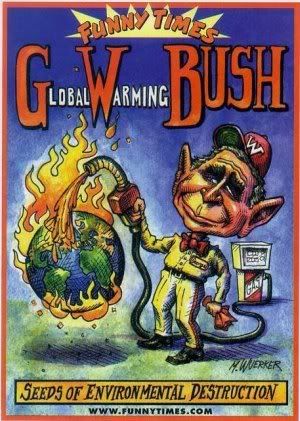
Bush is skipping UN forum on global climate change


Burn, baby burn!

The New York Times is reporting that the leader of the nation contributing the most to global warming won't even bother attending a meeting today at the United Nations. Instead he's going to create an alternate meeting later this week where polluters can decide for themselves how much they should reduce their CO2 emissions.

Bush's chief environmental adviser, James L. Connaughton (a former industry hatchet man for General Electric and ARCO), stated that:

“It’s our philosophy that each nation has the sovereign capacity to decide for itself what its own portfolio of policies should be.”

Perfect, a representative of the oil and electricity industries deciding on climate change policy. While we're at it let's allow the lumber industry to decide on the rules for deforestation and the mining industry to regulate Superfund cleanups. Oh wait, they already do.


[Read more →]
Adding Fuel to the FireSocialTwist Tell-a-Friend

Sep 3, 2007

African Exodus Linked to Global Climate Change

The climate crisis helped us emerge from the Stone Age, will it return us to it?


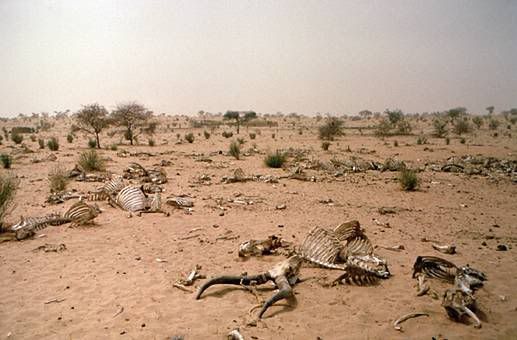
Drought stricken regions of Africa today may have looked the same for
our early ancestors.


As I wrote earlier (see The Evolution of Metapopulations and the Future of Humanity) the earliest migration of fully modern humans out of Africa occurred approximately 70,000 years ago. I argued that the most likely explanation was that global climate change, as the last ice age was beginning, prompted this migration.

This hypothesis found support today in the early edition of Proceedings of the National Academy of Sciences by Christopher Scholz and colleagues who have evidence from deep sediment cores of Lake Malawi in Africa. These cores suggest a series of megadroughts that occurred between 135,000 and 75,000 years ago that reduced Lake Malawi by as much as 95% and caused many lakes throughout Africa to dry up completely. Approximately 70,000 years ago the climate stabilized in the region and was more favorable for human populations.

There has been much speculation as to why humans didn’t invent farming until only 10,000 years ago in the fertile crescent of the Middle East. This early climate crisis was probably the main reason. For sixty thousand years the climate fluctuated and droughts would strike our fledgling species. This undoubtedly made it difficult for hunter-gatherers who had the freedom to follow the herds but near impossible for any would-be agriculturists tied to one area of land. Couple this with few potential large game animals suitable for domestication in Africa (see Guns, Germs & Steel) and it’s easy to understand why there was such a delay.

This might also give us modern humans pause as we hear more reports every day about catastrophic climate change. We are a species beholden to the land we occupy in ways that are easy to forget with modern technology. Sixty thousand years may be the blink of an eye in geologic terms, but it’s fifteen times longer than humans have had the written word. The last global climate change may have been caused by fluctuations in the Earth’s orbit, but the current one is the result of our own societal imbalance.

Reference:

Christopher A. Scholz et al. (2007). East African megadroughts between 135 and 75 thousand years ago and bearing on early-modern human origins. Proceedings of the National Academy of Sciences. Early Edition September 3, 2007. www.pnas.org doi 10.1073 pnas.0703874104


[Read more →]
African Exodus Linked to Global Climate ChangeSocialTwist Tell-a-Friend

Aug 19, 2007

Point of Inquiry with Chris Mooney


ScienceBlogger Chris Mooney (The Intersection) is featured in the latest interview at Point of Inquiry. His book Storm World, centers on the increasingly large storms that we can expect as a result of the climate crisis and the political forces that are opposing policy change.


[Read more →]
Point of Inquiry with Chris MooneySocialTwist Tell-a-Friend

Feb 22, 2007

'Green' Greed is Good

There are serious concerns for our nation's economic managers now that global warming has become an important political—rather than purely scientific—issue.

The world's leading economic powers are invested so fully in carbon fuel infrastructures that, on the surface, it would seem to spell economic disaster to alter course as dramatically as some environmentalist proponents argue.

However, there is a growing consensus among economic leaders that the financial impacts are more likely to occur if we don't take the warnings seriously. Just prior to the president's State of the Union address, CEOs from 10 of the nation's largest companies (including Alcoa, DuPont, Pacific Gas & Electric, Caterpillar, General Electric and Duke Energy) urged the president to apply mandatory federal emissions controls.

"Action is not only justified, it's critical—greenhouse-gas emissions are rising at an unprecedented rate," said Peter Darbee, CEO of PG&E, which provides energy to more than 15 million American homes. Even Dick Cheney's financial manager, Jeremy Grantham, sees where the energy wave is cresting.

Grantham, chairman of Boston-based GMO (which, according to FEC statements, manages at least $1.6 million of the vice president's investments), sent a strongly worded letter to the company's clients, including Cheney. "There is now nearly universal scientific agreement that fossil fuel use is causing a rise in global temperatures," Grantham stated—and he warned investors that industrialized countries with better fuel efficiency have, on average, enjoyed faster economic growth over the past 50 years than the United States.

The GDP (gross domestic product) per unit of energy in Italy is 50 percent higher than in the U.S., and in Japan it's 60 percent higher. Even China is passing us by in energy efficiency with, Grantham added, "auto fuel efficiency standards well ahead of the U.S.!"

Clean-energy policies, far from leading to economic stagnation, will likely foster innovation and emerging markets. Grantham's bottom line is that "oil substitution, energy conservation, and related environment issues will be the biggest investment issue of at least the next several decades."

Market opportunities are opening up for those entrepreneurs savvy enough to see what the future holds. In this way, "going green" means financial success along with environmental responsibility.


[Read more →]
'Green' Greed is GoodSocialTwist Tell-a-Friend