ERIC MICHAEL JOHNSON
_____________________________________________________________________________________________________

"If the misery of the poor be caused not by the laws of nature, but by our institutions, great is our sin."
- Charles Darwin
_____________________________________________________________________________________________________
Showing posts with label fossil humans. Show all posts

Mar 24, 2009

Bonobos in the Garden of Eden

Our primate cousins could turn the question of human origins upside down.


Could the bonobo homeland also be the origin of our common ancestor?
Image: Cyril Ruoso / Time

In an interview with Dan Harris on Nightline, bonobo researcher Dr. Bila-Isia Inogwabini recently suggested that humans may have first evolved in the Western area of the Democratic Republic of Congo rather than in East Africa where most of the fossil evidence has been discovered.
“I really strongly feel that people may have evolved from this region,” he said. "It’s a big claim, yes, I understand, but I really think it is worth it to put it on the table."
Genetic evidence suggests that humans, bonobos and chimpanzees shared a common ancestor between 4.6 to 6.2 million years ago (mya). One population eventually became the genus Homo while the other, Pan, diverged again about 1.3 mya to become modern day bonobos and chimpanzees. What remains unknown is where and why this Pan-Homo split occurred that sent our species along such a different evolutionary path.

The vast majority of hominin fossils have been found in eastern Africa, in what is modern day Ethiopia, Kenya and Tanzania. The most reasonable assumption has long been that it was in East Africa, near the Rift Valley, where the Pan-Homo division took place. However, the earliest hominin fossil find to date, Sahelanthropus tchadensis, is between 6-7 mya and was found in in the central African country of Chad (about 2,500 km away). S. tchadensis was much more ape-like than later Australopithecines and is thought to have coexisted alongside our common ancestor with chimpanzees and bonobos.

This early Chad find is important considering that the fossil record is so sparse between 12 mya and 4 mya (the crucial period as far as we're concerned). The only representatives of this vast period after S. tchadensis was Orrorin tugenensis (6 mya from Kenya) an ape species that may have been partially bipedal, Ardipithecus ramidus kadabba (5.5 mya from Ethiopia) and Ardipithecus ramidus ramidus (4.4 mya also from Ethiopia). All of these species were much more apelike than the Australopithecines, which first appear in the fossil record 4.15 mya in Kenya and 4.1 mya in Ethiopia. An excellent timeline at hominin.net helps put these dates and the location of the finds into context.


Fossil map showing many of the hominin fossil discoveries throughout Africa.
Image: National Geographic

While Ethiopia or Kenya would seem to be the most likely candidates for the split between Homo and Pan, the fact that the earliest known hominin has been found in Chad has raised some questions about this. Writing in the journal Nature about how the discovery of S. tchadensis changes our understanding of early human origins, Brunet. et al state:
This suggests that an exclusively East African origin of the hominid clade is unlikely to be correct. It will never be possible to know precisely where or when the first hominid species originated, but we do know that hominids had dispersed throughout the Sahel and East Africa by 6 Myr.
Furthermore, Australopithecus bahrelghazali (about 3.6 mya) was also discovered in Chad, suggesting that there is a great deal of material still to be discovered in this region. Later hominin fossils have also been discovered in South Africa (such as Australopithecus africanus and Paranthropus robustus). This means that the distribution of hominins extends all the way from Chad to East Africa to South Africa. Interestingly, the nearest central point between all these locations is the Democratic Republic of Congo.

This brings us to bonobos, the species that Dr. Inogwabini has studied for many years. Bonobos are found only in the DR Congo and had their last common ancestor with chimpanzees about 1.3 mya. Emory University primatologist Frans de Waal has argued that bonobos haven't changed much in the 4-6 million years since humans, chimpanzees and bonobos shared a common ancestor.
"The bonobo may more closely resemble the common ancestor of all three modern species," De Waal says. "It's an important issue that's yet to be resolved."
Remarkably, many of these traits are shared by only one other extant species: humans. Regular bipedalism, face-to-face mating (requiring a more ventral orientation of the vagina), reduced limb and body proportions, reduced canines, greater breadth of diet, larger group sizes and reduced competition within groups; all of these traits are shared more closely with humans than chimpanzees. Anatomically, bonobos show more similarities than chimpanzees to the early hominin Ardipithecus (5.5 mya). This could mean that bonobos are closer to the ancestral population and that chimpanzees diverged in order to adapt to different environmental pressures. But it could also be that early humans and bonobos experienced convergent evolution based on similar environments. At this point the evidence to address these questions is thin.
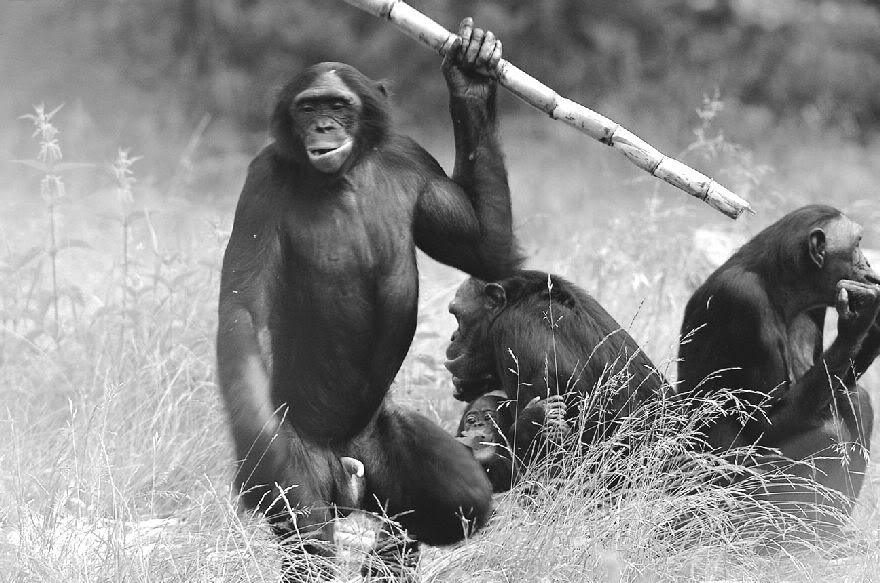

Bonobos are the only primate, other than humans, that regularly walk upright.
Image: Unattributed

Unfortunately, fossils are unlikely to help. Rain forest soils are notoriously bad for fossilization. The bones will decay long before minerals can replace the organic material. Even in ideal conditions (such as arid or anoxic environments) fossilization is extremely rare. So there is a certain amount of "environmental bias" in the fossil record. Unless an organism had a large enough range to be living in the right location for fossilization to occur, there will be no record that they ever existed. This could mean that the hominin fossils we do have were from individuals after they had migrated to the far edge of their original range and that the really exciting evolutionary events occurred in Central Africa. If this is the case, then the reason we have so many fossils from East Africa isn't because that was the cradle of humanity, it's just because the conditions were right for fossilization. Unfortunately, without evidence to test this hypothesis it remains in the realm of mere conjecture.

One piece of evidence that makes me think bonobos and humans might have shared more than just a similar environment has to do with a region of DNA promoting the release of oxytocin. At the AVPR1A gene both humans and bonobos (but not chimpanzees) share a repetitive microsatellite locus that Elizabeth Hammock and Larry Young have shown to be important for cooperation, empathy and social bonding. It is far more parsimonious that chimpanzees lost this repetitive microsatellite than for both humans and bonobos to independently develop the same mutation.

So if I had to make my best guess, I would put my money on the Pan-Homo split occuring in the mosaic environments of Central Africa near DR Congo. I would also predict that this common ancestor would appear more bonobo-like than chimpanzee-like. We may never know the real answer. But, considering the exciting "hobbit" fossils discovered on the island of Flores, Indonesia, it may be possible for fossilization to occur even in the rain forest if conditions are just right. At this moment, somewhere in a cave near Lac Tumba in the Democratic Republic of Congo, our common ancestor with bonobos and chimpanzees may be lying in wait for the next intrepid explorer to unearth. If so it would be the anthropological find of the century. Our long search to understand human origins would finally be at an end.


[Read more →]
Bonobos in the Garden of EdenSocialTwist Tell-a-Friend

Sep 21, 2007

The Original Cast of Survivor

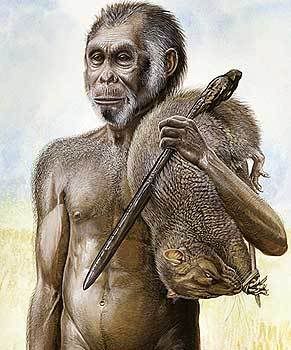
"The Hobbit" was a distinct species that adapted to an island habitat.


Homo floresiensis, our 3-foot tall hominin cousin also known as “The Hobbit,” lived approximately 18,000 years ago on the Indonesian island of Flores. There has been a great deal of debate about whether the skeletal material was from a unique species as originally described or was in fact a human with a growth disorder.

In the new edition of Science (subscription required), Matthew W. Tocheri and colleagues have analyzed the wrist bones of this controversial specimen and determined that the species retains a primitive morphology from before the origin of modern humans. Wrist elements can be powerful diagnostic tools in classification because the bones are so numerous and can undergo evolutionary changes through both adaptive pressures (such as morphologies necessary for grip structure or style of locomotion) or because of neutral changes as the result of reproductive isolation.

As the authors described the bones in the article released today:

Each is well preserved and shows no signs of pathology or abnormal development. . . . [T]hese three articulating bones display none of the shared, derived features of modern human and Neandertal carpals. Instead, they show the general symplesiomorphic pattern exhibited by all extant African apes, as well as fossil hominins that preserve comparable wrist morphology and date before 1.7 Ma.

A symplesiomorphy is any trait that exists in multiple living species and also in the most recent common ancestor of those species. Tocheri and his team determined that three of Homo floresiensis’ carpals (the trapezoid, scaphoid, and capitate) have more in common with living apes and extinct hominins (such as Homo habilis, Homo erectus and the Australopithecines) than they do with either modern humans or Neandertals. This places them as a distinct species whose lineage branched from the human family at least 1.7 million years ago and which lived contemporaneously with modern humans.


Homo floresiensis likely evolved from a population of Homo erectus that migrated into South East Asia. There is evidence from Sangiran and Mojokerto in Java (Indonesia) for three cranial specimens of Homo erectus from between 1.6 to 1.8 million years ago. Populations of erectus are known to have been in Zhoukoudian, China until sometime between 500,000 and 230,000 years ago. One population may have ended up trapped on the Indonesian island of Flores as the seas rose following the Gunz or Mindel glaciation (roughly 690,000 and 125,000 years ago respectively). The species then underwent a selection pressure for insular dwarfism, in which individuals are selected for smaller stature in order to adapt to the more limited resources that island habitats offer (examples include dwarf elephants from Malta or Crete, Channel Island mammoths and the pygmy dinosaur Europasaurus).

In this way, perhaps our smaller hominin cousins became the original cast of Survivor. Isolated on a remote island, cut off from the resources they'd formally been accustomed to and pitted against the elements in a life or death struggle. However, unlike the modern human contestants, our hobbit cousins didn't rely only on their wits and endurance in order to survive. Homo floresiensis adapted with their environment rather than trying to be masters of it. By doing so they ended up being the last remaining survivors of an ancient hominin lineage. If only they'd been able to survive a few thousand years longer. What we might have learned from each other would have been truly staggering.

Reference:

Matthew W. Tocheri, Caley M. Orr, Susan G. Larson, Thomas Sutikna, Jatmiko, E. Wahyu Saptomo, Rokus Awe Due, Tony Djubiantono, Michael J. Morwood, and William L. Jungers. (2007). The Primitive Wrist of Homo floresiensis and Its Implications for Hominin Evolution. Science 21(317):1743-1745. DOI: 10.1126/science.1147143


[Read more →]
The Original Cast of SurvivorSocialTwist Tell-a-Friend

Sep 3, 2007

African Exodus Linked to Global Climate Change

The climate crisis helped us emerge from the Stone Age, will it return us to it?


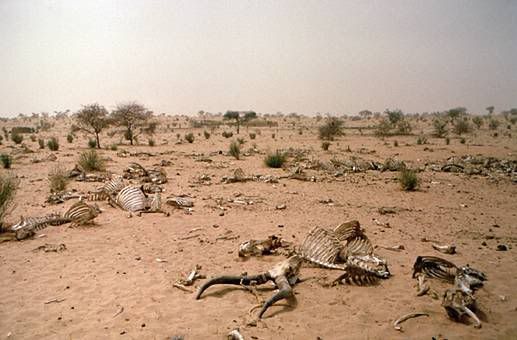
Drought stricken regions of Africa today may have looked the same for
our early ancestors.


As I wrote earlier (see The Evolution of Metapopulations and the Future of Humanity) the earliest migration of fully modern humans out of Africa occurred approximately 70,000 years ago. I argued that the most likely explanation was that global climate change, as the last ice age was beginning, prompted this migration.

This hypothesis found support today in the early edition of Proceedings of the National Academy of Sciences by Christopher Scholz and colleagues who have evidence from deep sediment cores of Lake Malawi in Africa. These cores suggest a series of megadroughts that occurred between 135,000 and 75,000 years ago that reduced Lake Malawi by as much as 95% and caused many lakes throughout Africa to dry up completely. Approximately 70,000 years ago the climate stabilized in the region and was more favorable for human populations.

There has been much speculation as to why humans didn’t invent farming until only 10,000 years ago in the fertile crescent of the Middle East. This early climate crisis was probably the main reason. For sixty thousand years the climate fluctuated and droughts would strike our fledgling species. This undoubtedly made it difficult for hunter-gatherers who had the freedom to follow the herds but near impossible for any would-be agriculturists tied to one area of land. Couple this with few potential large game animals suitable for domestication in Africa (see Guns, Germs & Steel) and it’s easy to understand why there was such a delay.

This might also give us modern humans pause as we hear more reports every day about catastrophic climate change. We are a species beholden to the land we occupy in ways that are easy to forget with modern technology. Sixty thousand years may be the blink of an eye in geologic terms, but it’s fifteen times longer than humans have had the written word. The last global climate change may have been caused by fluctuations in the Earth’s orbit, but the current one is the result of our own societal imbalance.

Reference:

Christopher A. Scholz et al. (2007). East African megadroughts between 135 and 75 thousand years ago and bearing on early-modern human origins. Proceedings of the National Academy of Sciences. Early Edition September 3, 2007. www.pnas.org doi 10.1073 pnas.0703874104


[Read more →]
African Exodus Linked to Global Climate ChangeSocialTwist Tell-a-Friend

Aug 20, 2007

A Three Million Year Walk Through Egypt

New hominid footprint has Intelligent Design advocate stumped


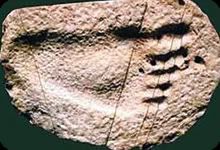
Zahi Hawass_________________Cast of fossilized footprint________

This is very confusing. The Scubaredneck (seriously, that's his name) writing at Uncommon Descent posted this article about a new fossil footprint in Egypt that might be older than the earliest evidence of Australopithecus afarensis. But he just posted the story as is from Reuters. Did he forget to inject his Intelligent Design message to show they’d predicted this all along? Is there something significant about Egypt having evidence of hominids earlier than Ethiopia? Are they changing their tactic to suggest that evolutionary anthropologists have been too conservative in their estimates about the age of A. afarensis? I really don’t understand why this would be posted on William Dembski’s page. Can someone explain it to me?

CAIRO (Reuters) - Egyptian archaeologists have found what they said could be the oldest human footprint in history in the country’s western desert, the Arab country’s antiquities’ chief said on Monday.

“This could go back about two million years,” said Zahi Hawass, the secretary general of the Egyptian Supreme Council of Antiquities. “It could be the most important discovery in Egypt,” he told Reuters.

Archaeologists found the footprint, imprinted on mud and then hardened into rock, while exploring a prehistoric site in Siwa, a desert oasis.

Scientists are using carbon tests on plants found in the rock to determine its exact age, Hawass said.

Khaled Saad, the director of prehistory at the council, said that based on the age of the rock where the footprint was found, it could date back even further than the renowned 3-million year-old fossil Lucy, the partial skeleton of an ape-man, found in Ethiopia in 1974. (emphasis added by The Scubaredneck)

He probably thinks that Reuters' use of the word "human" means modern humans. I can see him grinning with excitement as he posted the story. If only a dinosaur footprint had been just next to it he might have had an aneurysm.

In all seriousness, the indentations at the heel and big toe are consistent with the footprints from Laetoli and could be further evidence of early hominid bipedalism. This would provide additional evidence that our ancestors walked upright before large brains had evolved. However, the assessment that this dates from earlier than 3 million years ago was based purely on one person's interpretation prior to a full analysis (notice how there were two age estimates in the same article), so I look forward to this evidence being presented in a journal. Because, unlike the Intelligent Design advocates, I don’t take random media clips as evidence for anything.


[Read more →]
A Three Million Year Walk Through EgyptSocialTwist Tell-a-Friend

Aug 9, 2007

Apparently Not Very Long

Leakey confirms what Intelligent Design already knew


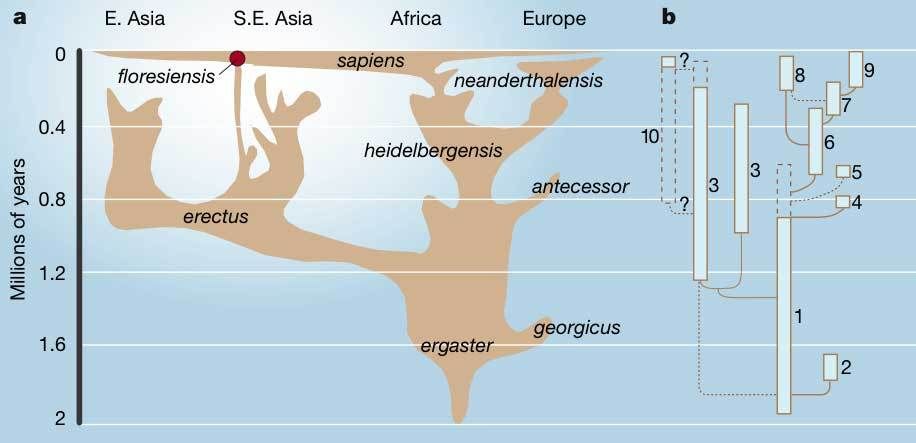
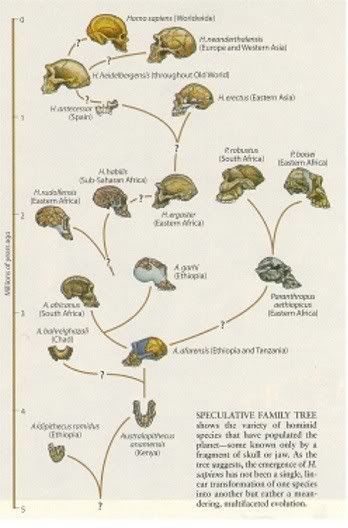
One (of many) adaptive radiation diagrams of hominid evolution.
From Scientific American, January 2000, “Once We Were Not Alone”, page 60


Yesterday (at 3:19 pm) I posted commentary about the recent finds from Koobi Fora suggesting that Homo habilis and Homo erectus lived during the same period for at least part of their existence (however, see the terrific critique of the study at Anthropology.net). This put the final nail in the coffin for an idea that had been losing support for thirty years: that human evolution was a linear progression. I ended the post with the question:


How long do think it will take before the Creationist/Intelligent Design crowd jumps on this story to claim they were right all along?

Answer: 22 hours 51 minutes.

The Discovery Institute has now announced that the Nature study only reveals "one of Jonathan Wells' points in chapter 11 in Icons of Evolution." See, they knew all along. Wait, did they say Jonathan Wells? Jonathan Wells was arguing that human evolution occurred through a bushy distribution rather than a linear progression? Jonathan Wells who stated "my prayers convinced me that I should devote my life to destroying Darwinism" was actually a closet supporter of adaptive radiation?

Perhaps I've misjudged the man. Wells does quote the adaptive radiation argument for human evolution presented by Stephen Jay Gould:

“Humans represent just one tiny, largely fortuitous, and late-arising twig on the enormously arborescent bush of life.”

But then he takes great umbrage with the statement. So where exactly did Jonathan Wells predict the recent findings from Koobi Fora? There's quite a lot about the Piltdown Man hoax, however surprisingly little detailed analysis of actual fossils. I'd be very interested to hear the answer to that.

How long do think it will take before the Discovery Institute gets back to me on that question? I'm guessing somewhat longer.


[Read more →]
Apparently Not Very LongSocialTwist Tell-a-Friend

Aug 8, 2007

A Family Reunited

Homo habilis and Homo erectus shared the family dinner table, but probably ordered different meals.


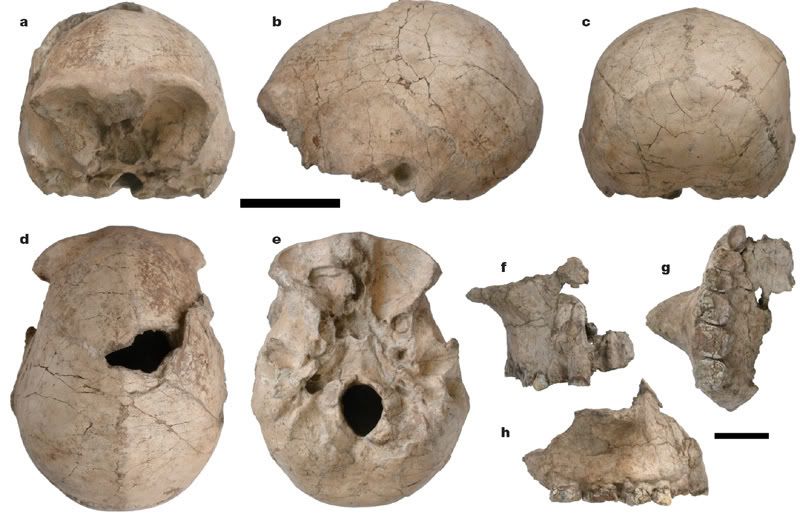
Two new fossil discoveries from Kenya described in the current issue of Nature show that Homo habilis and Homo erectus lived contemporaneously. According to today’s New York Times:

Scientists who dated and analyzed the specimens — a 1.44 million-year-old Homo habilis and a 1.55 million-year-old Homo erectus — said their findings challenged the conventional view that these species evolved one after the other. Instead, they apparently lived side by side in eastern Africa for almost half a million years.

The conventional view has been that Homo habilis was the ancestor of H. erectus and that there was a linear progression along that particular evolutionary branch.

This interpretation has always been suspect to me for, as a good student of evolution knows, linear and evolution rarely go hand in hand (and progression never). Evolutionary history is a complex branching tree without direction or purpose. This doesn’t imply randomness (please take note creationists), but rather demonstrates how organisms adapt to their local environments instead of progressing to some ultimate goal.

The fact that the two hominid species lived together in the same lake basin for so long and remained separate species, Dr. Meave Leakey said in a statement from Nairobi, “suggests that they had their own ecological niche, thus avoiding direct competition.” For example, the two may have had foraging and dietary differences.

In any case, Dr. Leakey said, “Their co-existence makes it unlikely that Homo erectus evolved from Homo habilis.”

What this could imply is sympatric speciation from a common ancestor, in which a subpopulation of early Homo adapted to a different ecological niche and remained reproductively isolated from the main population. The later descendants of these subpopulations became habilis and erectus. Another possibility is that a geographic barrier isolated these two subpopulations long enough for them to adapt along separate trajectories. Later, a million years later or so, when this barrier no longer existed the two species then interacted but were distinct enough from each other that they didn’t compete over the same resources.

The new findings, Dr. Lieberman said, highlight the need for obtaining more fossils that are more than two million years old. In addition, he said, they show “just how interesting and complex the human genus was and how poorly we understand the transition from being something much more apelike to something more humanlike.”

How long do you think it will take before the Creationist/Intelligent Design crowd jumps on this story to claim they were right all along?

Have you made your guess? For the answer click here to see if you were right.

UPDATE: For an excellent review (and critique) of this Nature article see Anthropology.net

Reference:

F. Spoor, M. G. Leakey, P. N. Gathogo, F. H. Brown, S. C. Antón, I. McDougall, C. Kiarie, F. K. Manthi & L. N. Leakey
(2007). Implications of new early Homo fossils from Ileret, east of Lake Turkana, Kenya. Nature 448: 688-691.


[Read more →]
A Family ReunitedSocialTwist Tell-a-Friend