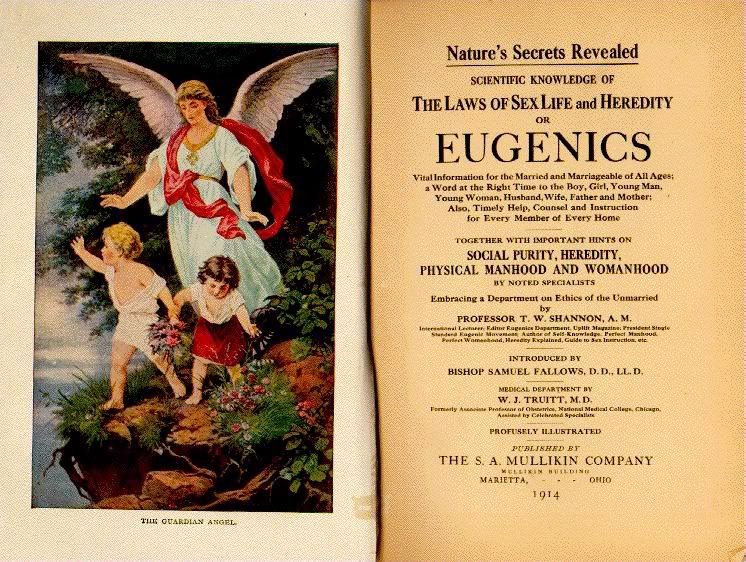
New study breaks the silence and suggests voter apathy could be explained by the genes.

Front page from the 1914 American textbook Eugenics by Professor T.W. Shannon
Genetics and political science have had an ugly association in the past. Arguments that certain people were biologically “unfit” for the political process led to an
official eugenics policy in the United States that continued up until the Second World War. This was based largely in prevailing views about racial inferiority.
For example, writing in 1907
Davis Rich Dewey notes (p. 163):
The white population of the South honestly believed that political activity and privilege was bad for the colored race. . . The inferiority of the negro was still held to be a demonstrated fact.
This “demonstrated fact” motivated the Jim Crow voting exclusion laws and anti-miscegenation legislation such as the
Racial Integrity Act of 1924.
Given this history you’d suspect few political scientists would be willing to link the fields of genetics and politics, even if they’re clearly separated from the racist views of the past. However, political scientist James Fowler and colleagues have suggested just such a connection in a study they reported on at the American Political Science Association.
In trying to predict who will vote and who will stay home, researchers have tried in vain to find any patterns in age, gender, race, income, or level of education. This is a question of some urgency since fewer than 50% of US citizens regularly vote in presidential elections. In order to determine if genes played any role the researchers collected voting data on 442 identical and 364 fraternal twins and found that 72 percent of the differences in voting turnout and around 60 percent of the differences in political activity could be explained by genetics alone (though those numbers are disputed).
According to a review in the current issue of
Scientific American:
If genes do in part control voting, a single gene is unlikely to be responsible—hundreds of genes are probably involved, suggests behavioral geneticist Robert Plomin of King’s College London. Fowler hypothesizes that because “we obviously did not vote in large-scale elections in the Pleistocene,” the drive to vote or participate in politics may be linked with genes underlying more ancient behaviors, such as innate dispositions toward cooperation. The search for any such genes in our primate relatives could help determine “whether we share the neurobiological underpinnings of cooperation or whether humans are unique in this respect,” Fowler adds.
This study doesn’t suggest that genetics can account for political differences (though
another study tries to make that claim), merely a willingness to engage in the political process. As it happens, studies on such neurobiological underpinnings of cooperation in non-human primates have been undertaken, including with our closely related cousins the chimpanzees and bonobos.

Bonobos sharing cantaloupe
Image: David EppsteinAccording to research by Brian Hare and colleagues published in the journal
Current Biology (subscription required) bonobos were found to be more successful than chimpanzees in cofeeding trials that tested their emotional reactivity. Bonobos were shown to be consistently more tolerant, were able to cooperate more effectively and, as a result, ended up receiving a greater food reward than the more individualistic chimps. While it’s a far cry from representative democracy, what the bonobo study demonstrates is that neurobiological processes (and potentially even genetic differences) can go a long way in promoting cooperative behavior and social engagement.
So perhaps Fowler’s study isn’t as far fetched as it may initially appear. However, there are numerous additional factors that should be considered before throwing up our hands and blaming our faulty genes. For example, the
International Institute for Democracy and Electoral Assistance has demonstrated that since WWII Western Europe has had the largest voter turnout in the world while North America has had the third lowest. Would anyone seriously suggest that genetic factors account for this difference? Certainly higher education standards, a news media that informs rather than provokes and greater worker participation in collective bargaining play some role. Understanding genetic factors can provide some interesting insights into political motivations but, like those who challenged injustice in our nation’s past, in order to turn our broken election system around we’ll need to follow our bonobo cousins and work together to achieve a larger reward.

 [Read more →]